
Any Questions? Email Us
Talk to an Expert

The Ama Dablam Expedition is one of Nepal’s most iconic and technically demanding Himalayan climbing adventures, attracting experienced mountaineers from around the world who seek to climb a spectacular 6,812-meter peak in the Everest region. Known for its striking pyramid-shaped profile, dramatic ridges, steep faces, and exposed climbing sections, Ama Dablam stands as a symbol of Himalayan mountaineering. For climbers looking for a challenging high-altitude expedition in Nepal that combines technical climbing, breathtaking scenery, and authentic Sherpa culture, the Ama Dablam Expedition offers an unforgettable experience in the heart of the Himalayas.
Located in the Khumbu region of Nepal, Ama Dablam rises prominently above the famous Everest trekking routes. Its name is commonly associated with the Sherpa words for “mother” and “necklace,” reflecting the mountain’s distinctive appearance. The hanging glacier between its peaks resembles a traditional double-pendant necklace worn by Sherpa women. This unique natural formation, combined with the mountain’s dramatic architecture, has made Ama Dablam one of the most photographed and recognizable peaks in the world.
Unlike many trekking peaks in Nepal, Ama Dablam climbing requires advanced mountaineering skills, strong physical preparation, previous high-altitude experience, and the ability to operate safely on technically challenging terrain. Climbers encounter steep snow, ice, rock, exposed ridges, fixed-line climbing, and changing Himalayan weather conditions. The expedition therefore requires careful acclimatization, professional leadership, appropriate climbing equipment, and disciplined decision-making throughout the journey.
For the Ama Dablam Expedition 2027/2028, climbers can expect a carefully structured itinerary designed around acclimatization, technical preparation, and progressive altitude gain. The expedition generally begins with arrival in Kathmandu, followed by a scenic flight toward the Everest region and a trek through traditional Sherpa settlements toward Ama Dablam Base Camp. The approach provides opportunities to experience iconic Himalayan landscapes while gradually adapting to increasing altitude.
The route toward Base Camp passes through spectacular locations in the Khumbu, including Namche Bazaar and other mountain villages surrounded by some of the highest peaks on Earth. The journey itself becomes an important part of the expedition, offering panoramic views of Everest, Lhotse, Nuptse, Ama Dablam, Thamserku, and other Himalayan giants. At Base Camp, climbers transition from trekking to expedition mode, preparing for rotations, technical climbing practice, and the summit push.
A major feature of the Ama Dablam climbing route is its technical nature. The mountain is commonly approached through established climbing lines involving rock, mixed terrain, snow, and ice. Climbers typically establish and use higher camps during the ascent, depending on expedition conditions and the climbing strategy. The upper mountain presents increasingly demanding terrain where technical ability, endurance, acclimatization, teamwork, and sound judgment become critical.
The best time for an Ama Dablam Expedition in Nepal is generally during the pre-monsoon spring and post-monsoon autumn climbing seasons. Autumn is particularly popular because of relatively stable weather and clear mountain views, while spring can provide favorable climbing conditions before the monsoon. However, Himalayan weather is unpredictable, and expedition schedules must remain flexible to respond to changing conditions.
Outward Adventure Treks provides professional expedition support for climbers preparing to take on Ama Dablam. Our approach focuses on experienced leadership, careful logistics, acclimatization planning, quality expedition support, and responsible Himalayan travel. From Kathmandu arrangements and the approach trek to Base Camp logistics and high-altitude expedition coordination, our team works to create a structured environment in which experienced climbers can concentrate on the technical and physical demands of the mountain.
Ama Dablam is not simply another Himalayan summit. It represents a significant mountaineering challenge for climbers who want to progress beyond trekking peaks and experience the demanding environment of a major technical Himalayan expedition. Its combination of altitude, steep terrain, exposed climbing, spectacular surroundings, and Sherpa heritage makes it one of Nepal’s most sought-after climbing objectives.
For mountaineers planning their next major challenge, the Ama Dablam Expedition 2027/2028 offers an opportunity to test climbing skills, endurance, preparation, and decision-making against one of Nepal’s most beautiful mountains. With thorough preparation, appropriate experience, professional expedition support, and respect for the Himalayan environment, the journey toward the summit can become one of the most rewarding achievements in a climber’s mountaineering career. Choose Outward Adventure Treks for a professionally coordinated Ama Dablam climbing experience and prepare to enter the extraordinary world of high-altitude mountaineering in Nepal’s legendary Khumbu Himalaya.
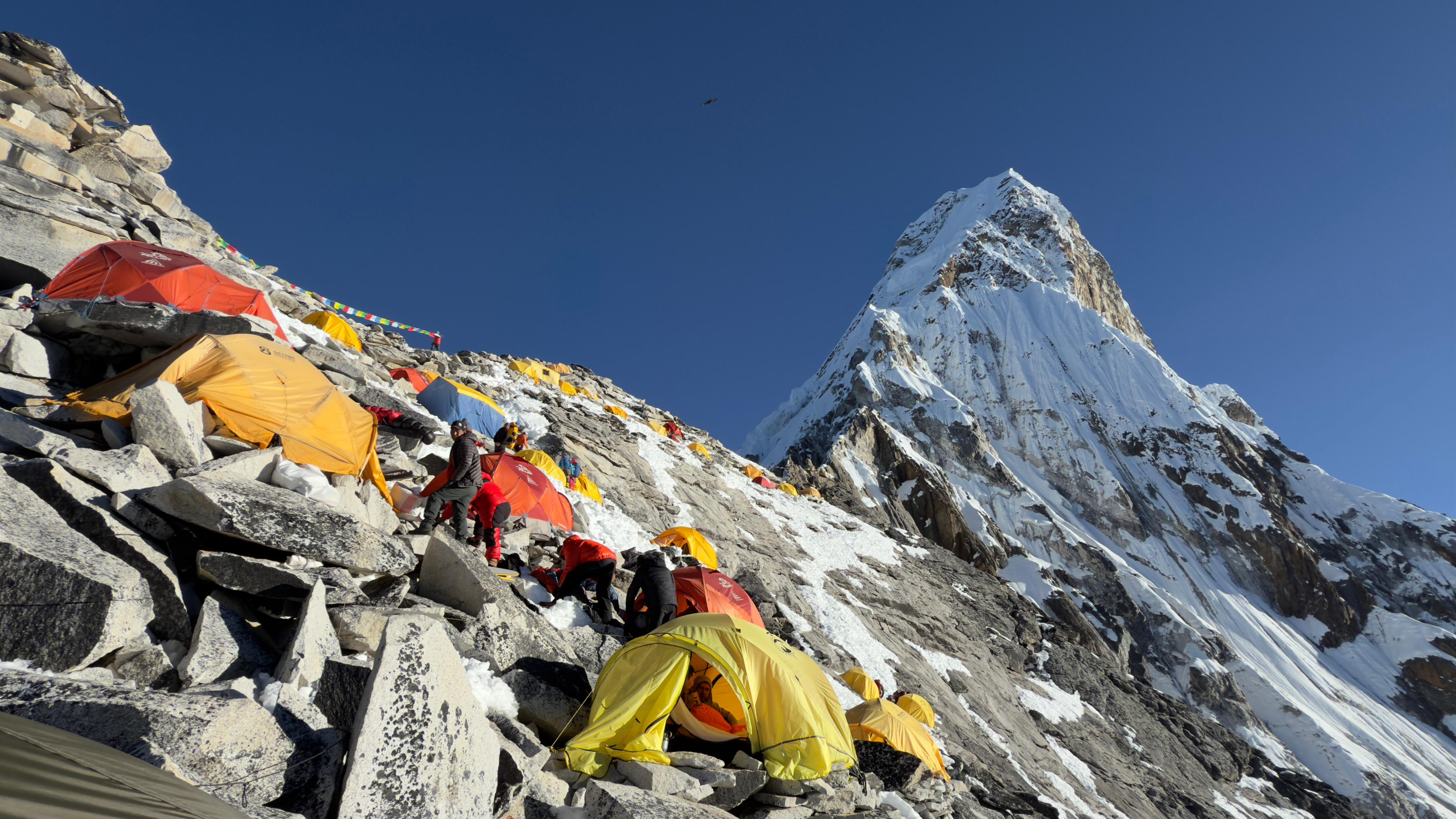
The Ama Dablam Expedition is considered one of the more technically demanding climbing objectives in Nepal, despite its 6,812-meter elevation being significantly lower than Mount Everest. The main reason is that Ama Dablam combines high altitude with sustained technical climbing on rock, snow, and ice. The commonly climbed Southwest Ridge includes steep sections, exposed ridges, fixed-rope climbing, and challenging mixed terrain. Experienced climbers have described the mountain as requiring genuine rock- and ice-climbing ability in addition to previous high-altitude experience.
Comparing Ama Dablam with Mount Everest is interesting because the two mountains demand different types of strength and experience. Everest is much higher at 8,849 meters, meaning altitude, prolonged acclimatization, extreme cold, and the effects of very thin air become major factors. Ama Dablam, at 6,812 meters, does not reach the same extreme altitude, but its technical climbing is more concentrated. The Southwest Ridge involves significant rock, ice, steep snow, and exposure, making technical movement a central part of the challenge. For this reason, Ama Dablam can be technically harder than Everest in particular sections, even though Everest presents the greater overall altitude challenge.
Mera Peak is considerably different from Ama Dablam. At approximately 6,476 meters, Mera is higher than many trekking peaks but is generally regarded as a more straightforward climbing objective, with the principal challenge coming from altitude, endurance, glacier travel, and changing mountain conditions rather than sustained technical rock climbing. Ama Dablam demands a substantially higher level of technical climbing ability because its route includes exposed rock and steep snow and ice terrain. Consequently, Mera Peak can be an important high-altitude experience, while Ama Dablam represents a significant step toward advanced technical Himalayan mountaineering.
Island Peak (Imja Tse) reaches about 6,189 meters and is widely used as an introduction to Himalayan peak climbing. It provides experience with crampons, ropes, glacier terrain, and steep climbing, but the overall technical commitment is generally lower than on Ama Dablam. Ama Dablam's Southwest Ridge introduces more sustained exposure and technically demanding sections, particularly around the higher camps and ridge system. Modern mountaineering reports also identify Island Peak as a popular technical training peak, while Ama Dablam is described as a highly technical Khumbu mountain.
Lobuche East is another popular climbing peak in the Everest region and reaches approximately 6,119 meters. Compared with Ama Dablam, Lobuche East generally provides a less sustained technical challenge, although conditions can make any Himalayan climb demanding. Ama Dablam combines greater altitude with a more complex and exposed climbing route, requiring climbers to manage technical terrain while operating in a high-altitude environment. This makes Ama Dablam a considerably more advanced objective for climbers seeking a serious technical expedition.
An Ama Dablam Expedition should not be confused with an 8,000-meter expedition. Mountains such as Everest, Manaslu, Lhotse, and other 8,000-meter peaks present a much greater physiological challenge because climbers operate at substantially higher elevations. However, Ama Dablam can be an excellent progression toward advanced Himalayan mountaineering because it develops experience in technical climbing, fixed-rope movement, exposure, high-altitude decision-making, and expedition discipline. The mountain therefore occupies an interesting position: it is lower than the world's 8,000-meter peaks but technically serious enough to demand strong preparation and previous climbing experience.
The difficulty of Ama Dablam Expedition comes from the combination of technical terrain rather than altitude alone. Climbers may encounter steep rock sections, snow slopes, ice, exposed ridges, and changing conditions. Historical route descriptions identify the climbing between the lower camps as particularly technical, including the Yellow Tower and steep terrain toward the upper camps. Conditions can also change from season to season, meaning the precise character of the route cannot be assumed to remain identical every year.
For Outward Adventure Treks, the Ama Dablam Expedition is therefore positioned as an advanced Himalayan mountaineering objective rather than a beginner's peak. Climbers should approach it with appropriate previous climbing experience, strong physical preparation, technical competence, acclimatization, and professional expedition support. The mountain's combination of spectacular scenery and serious technical climbing makes it one of Nepal's most distinctive mountaineering challenges.
In simple terms, Island Peak and Lobuche East are generally more accessible climbing objectives, Mera Peak places greater emphasis on altitude and endurance, Ama Dablam brings a much stronger technical and exposure component, and 8,000-meter expeditions introduce substantially greater altitude and physiological demands. The exact difficulty varies with route conditions, weather, snow and ice conditions, climber experience, and expedition strategy. Ama Dablam's reputation comes from this balance of altitude and technical climbing: it is not Nepal's highest mountain, but it is undoubtedly one of its most demanding and recognizable technical peaks.
The Ama Dablam Expedition success rate should be presented carefully, because there is no single universally accepted percentage that applies to every year, route, or climber. The Himalayan Database records expedition-level and individual member-level outcomes, and its current database covers expeditions through 2025. It reports more than 11,600 expeditions across the Nepal Himalaya overall, but a peak-specific success rate needs to be calculated from the Ama Dablam records rather than applying the overall Himalayan figure.
For an Ama Dablam expedition, success means reaching the summit, but the percentage can vary substantially between expedition seasons. Weather, route conditions, availability of fixed ropes, snow and ice conditions, acclimatization, climber experience, health, and the number of usable summit-weather windows can all affect the outcome. Therefore, quoting a fixed figure such as “Ama Dablam Expedition has an 80% success rate” without specifying the dataset and period can be misleading.
Ama Dablam is a popular commercial expedition, and established expedition operators provide structured logistics, experienced mountain guides, acclimatization schedules, fixed-rope systems, Base Camp support, and high-altitude Sherpa assistance. These factors can improve the probability that appropriately experienced climbers reach the summit. Historical Himalayan Database records demonstrate that successful Ama Dablam expeditions have included climbers reaching the summit without supplemental oxygen, although individual expedition strategies differ.
However, a commercial expedition does not guarantee a summit. Ama Dablam remains a technical 6,800-meter-class mountain, and climbers can turn around because of weather, route conditions, physical limitations, or safety considerations. In 2025, for example, Nepal recorded two separate fatalities during Ama Dablam expeditions, illustrating that the mountain remains a serious mountaineering objective despite its popularity.
Experience Has a Major Influence
This distinction is particularly important for Ama Dablam because technical ability matters alongside altitude experience. The mountain requires climbers to operate efficiently on steep and exposed terrain while dealing with high-altitude conditions. A climber who reaches Base Camp successfully has not necessarily demonstrated that they are ready for the upper technical sections.
Weather and Route Conditions
This is why responsible expedition operators normally build flexibility into the itinerary rather than treating a particular summit date as guaranteed. The objective should be to maximize the opportunity for a safe summit attempt rather than simply maximize the percentage of climbers who reach the top.
For climbers considering the Ama Dablam Expedition 2027/2028 with Outward Adventure Treks, the historical success rate should be viewed as a reference point rather than a promise. A successful expedition depends on the individual climber's experience and preparation, the expedition team's management, acclimatization, weather, route conditions, and the availability of a safe summit window.
The Himalayan Database is particularly useful because it maintains expedition records containing information about summits, deaths, accidents, routes, camps, oxygen use, and individual expedition members, allowing historical performance to be examined rather than relying solely on marketing claims. For Outward Adventure Treks, emphasizing preparation, experienced expedition leadership, appropriate technical skills, acclimatization, and conservative safety decisions provides a more credible picture of what determines success on the Ama Dablam Expedition.
The Ama Dablam Expedition 2027/2028 is a remarkable opportunity for experienced mountaineers seeking a technically challenging Himalayan adventure in Nepal. At 6,812 meters, Ama Dablam may be lower than Mount Everest, but its steep rock, snow and ice sections, exposed ridges, high-altitude environment, and changing weather make it a serious expedition objective. Success depends on more than physical fitness—it requires previous climbing experience, technical skills, proper acclimatization, careful preparation, favorable weather, and sound decisions throughout the ascent. For climbers searching for a challenging technical mountain expedition in Nepal, Ama Dablam offers an exceptional combination of mountaineering difficulty, spectacular Khumbu scenery, and authentic Himalayan experience.
Outward Adventure Treks provides professional expedition coordination for climbers preparing for the Ama Dablam Expedition in Nepal, with an emphasis on experienced leadership, expedition logistics, acclimatization, safety, and responsible mountain travel. Whether your goal is to advance your Himalayan climbing experience or take on one of Nepal’s most recognizable technical peaks, Ama Dablam demands respect, preparation, and commitment. With the right experience and a carefully managed expedition strategy, the journey toward the summit can become a defining achievement in your mountaineering career.
 Sep 19, 2026
Tharpu Chuli (Tent Peak) Climbing: Complete Nepal Peak Climbing Guide Tent Peak Climbing, also known as Tharpu Chuli Pe...
Read More Sep 15, 2026
Mera Peak Climbing with Heli Shuttle Mera Peak Climbing with Heli Shuttle is an extraordinary Himalayan adventure that...
Read More Sep 12, 2026
Namche Bazaar: The Gateway to Everest Trekking and Sherpa Culture Namche Bazaar is one of the most famous mountain sett...
Read More Sep 10, 2026
Peak Climbing vs. Expedition in Nepal: Understanding the Difference Nepal is one of the world’s premier destinati...
Read More
Leave a Comment